“The Circle of One”
AMULET AS MONUMENT

The art of indigenous civilizations is never just “art” – certainly not to its makers and its users. A mask, a utensil, an adornment is always invested with more than just grace and beauty; it partakes of and embodies a universal harmony, a well-being in the world that, if anything, the object focuses like a lens. We in “advanced” civilization can grasp that concept; but can we be affected by that power? After all, these objects are not central to our existence. Can they be at least central to our awareness?

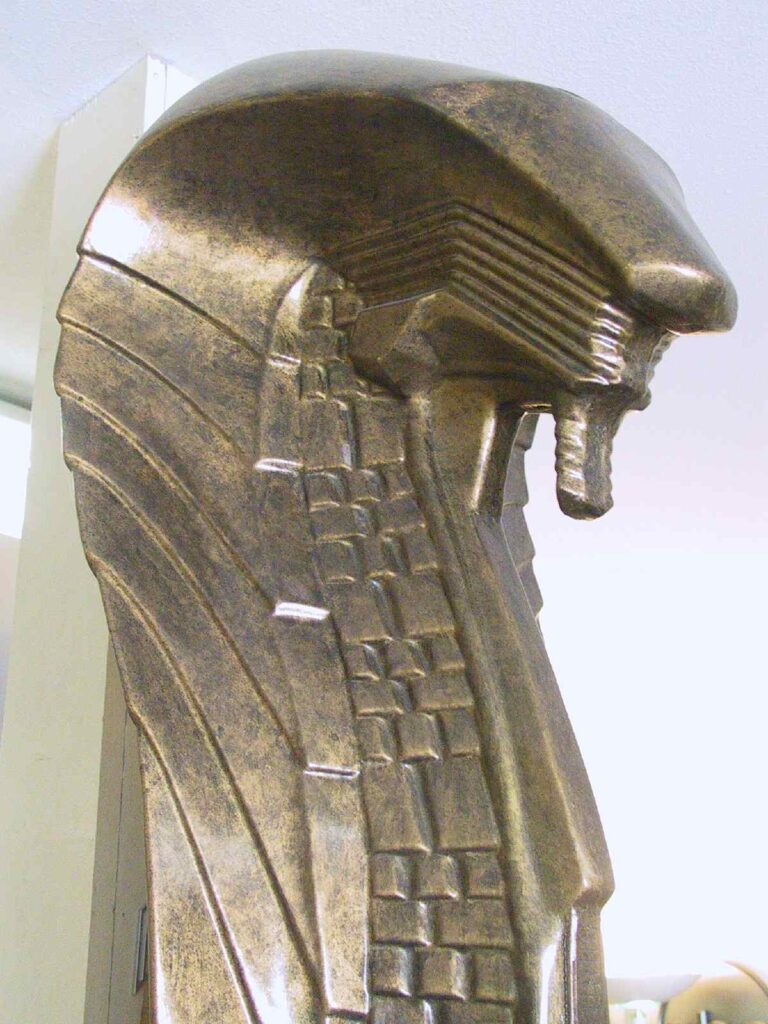
Antoine Bonsorte and Abram Zinberg seek to make them central to our awareness. Zinberg and Bonsorte have made an aesthetic decision to expand the size of tribal objects – a choice that also becomes a rhetorical device for communicating the extra-aesthetic power of such objects. Up-scaling objects does not invariably guarantee the amplification of their effect, certainly not in an environment littered with logos, billboards, and other signs designed to capture and command our attention. But by comprehending each original object at once as sculpture and as amulet – as a thing fashioned by a human and as a thing invested with uncommon energy by its formal relationship to our symbolic understanding of our world – Bonsorte and Zinberg translate the power. Rendered large, these once hand-sized configurations regain their magic, conveying their gravitas to people who would not have seen or recognized it on its original scale.

These are self-contained sculptures modeled on forms found in tribal art, their material, surface, and to some extent contour and volume modified without betraying the original essential qualities of each. The amulet has now become a monument, its presence asserted in our culture to an extent similar to that it asserts in tribal culture. Zinberg and Bonsorte have made sure that we can no longer view these objects as “primitive accessories.” They have never been either “primitive” or “accessories,” and building them at this scale simply drives that home.

Bonsorte and Zinberg, sensitive to the power of symbol – not just for the indigenous person, but for all people of the earth – recognize the particular significance of the circle as a universal embodiment of singularity and origin. The zero, the dot, the atom, the void, the egg, the cycle, the endless line, the omnidirectional surface – the circle doesn’t simply represent these profound fundaments, it exemplifies their physical as well as metaphysical existence. The circle signifies to us that perfection exists, and it exists not at the end of our journey but at the beginning of our being – or, rather, that it exists at both beginning and end, because as the shape shows the end is the beginning.

     This is not to imply that Zinberg and Bonsorte’s sculptures are “perfect.” Indeed, it is not to imply that the original objects are perfect, or that what humans can produce, in whatever cultural context, can be perfect.  After all we are not gods; perfection is a concept to us, a force of nature rather than a tool.  These sculptures are translations of the concept of perfection into terms we early-21st-century Westerners cannot diminish or ignore. Sheltering and dramatic where once they had been intimate and iconic, these transformations of indigenous artistry into modern artistry serve as bridges to the power behind all things, the power that connects mind to cosmos.s

Peter Frank
Los Angeles
March 2007

2007 © Bonsorte-Zinberg. All Rights Reserved • Webmaster: Antoine Bonsorte
To subscribe to our email list click here

BONSORTE DESIGN STUDIO
2401 Lincoln Boulevard Santa Monica, CA 90405 • 310 450 5200